

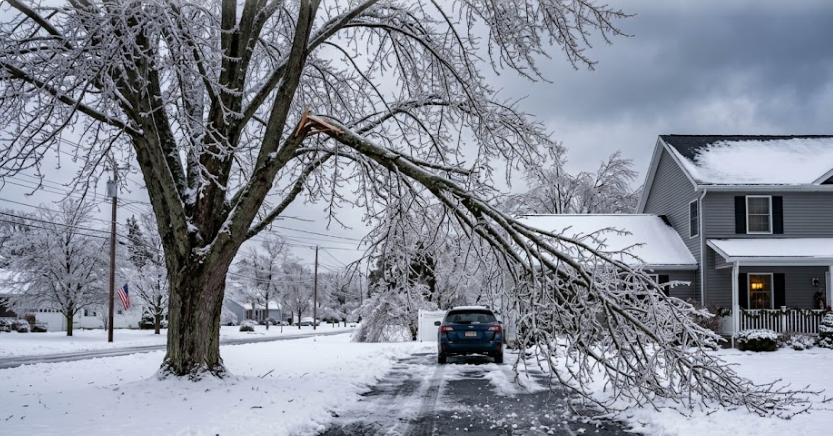
The morning after a bad ice storm in Northeastern PA usually looks the same: cracked limbs hanging over the driveway, a split tree leaning toward the house, and a homeowner standing in the yard wondering what’s safe to touch. That moment is when most people make their worst decisions, because the instinct is to start cleaning up right away.
Storm season tree safety in Northeastern PA comes down to one rule: slow down and assess before you touch anything. Heavy snow, freezing rain, and the high winds that roll through Wyoming, Lackawanna, and Susquehanna counties leave behind hazards that aren’t always obvious. A limb that looks settled can still be under enough tension to snap back. A line tangled in branches can be alive even if the power is out.
Here’s exactly what to do after heavy snow or ice damage, in the right order, so you stay safe and avoid making a bad situation worse.
In This Article:
- First Hour After the Storm: What to Check and What to Avoid
- Downed Power Lines and Trees: The One Mistake That Can Be Fatal
- How to Spot a Hazardous Tree After Snow or Ice
- Why Ice and Snow Damage Is Worse in Northeastern PA
- What You Can Safely Handle and What Needs a Pro
- Documenting Damage for Insurance
- Frequently Asked Questions
- When to Call for Storm Damage Tree Service
First Hour After the Storm: What to Check and What to Avoid
Before you step outside, look out a window first. The goal in the first hour is to identify hazards from a distance, not to start hauling branches.
Walk the property slowly and keep your eyes up, not just on the ground. The most dangerous things after a storm are usually overhead: partially broken limbs caught in the canopy, often called “widowmakers,” and limbs bent under snow load that are holding tension. Stay clear of anything hanging, leaning, or tangled.
A few things to avoid in that first window:
- Don’t walk directly under damaged limbs, even ones that look stuck in place.
- Don’t pull on branches that are wedged or bent. They can release with surprising force.
- Don’t use a chainsaw on anything overhead or under tension, especially on a ladder.
- Don’t assume a quiet, leaning tree is stable. Saturated or frozen soil can let a root system give way hours after the wind stops.
If everything looks clear and low to the ground, light cleanup is reasonable. If anything is overhead, leaning, or near wires, leave it and keep reading.
Suggested image: A snow-laden tree with a cracked limb hanging over a residential driveway. Alt text: “Ice-damaged tree limb hanging over a driveway in Northeastern PA after a winter storm.”
Downed Power Lines and Trees: The One Mistake That Can Be Fatal
This is the part of storm cleanup that actually kills people, so it gets its own section.
After ice and wind, trees and power lines come down together constantly across our region. The fatal mistake is assuming a line is dead because the power is out, or because a wire “looks like” cable or phone line. According to the Pennsylvania Public Utility Commission, all downed lines should be treated as energized and dangerous, and you should stay at least 30 feet away from downed wires.
It gets more dangerous than just the wire itself. A downed line can energize anything it’s touching, including a fence, a tree limb, or standing water, and high-voltage electricity can jump to anyone who gets too close. That tree leaning on your service line is not something to clear yourself. Assume it’s live.
If a line is down on or near your property:
- Stay back at least 30 feet and keep children and pets away.
- Assume every downed wire is live, including ones that look like cable or phone lines.
- Don’t touch anything in contact with the line: branches, fences, vehicles, or puddles.
- Call 911 and your utility immediately. In our area, that’s typically PPL Electric or PennDOT for road hazards.
- Never try to move a line with a stick, branch, or any tool. The Electrical Safety Foundation notes that even wood or cloth can conduct electricity when slightly wet.
No tree, driveway, or fallen limb is worth this risk. Wait for the utility to confirm the line is de-energized before anyone, including a tree crew, touches the tree.
How to Spot a Hazardous Tree After Snow or Ice
Once power lines are ruled out, the next job is figuring out which trees are still dangerous. Storm damage isn’t always dramatic. Some of the worst hazards are subtle.
Warning signs to look for from a safe distance:
- A fresh lean that wasn’t there before, especially with soil heaving or cracking at the base.
- Split or cracked trunks, including vertical cracks or a V-shaped fork that has started to separate.
- Hanging or broken limbs caught in the canopy.
- Partially uprooted root plates, where one side of the root system has lifted.
- Bark torn away in large sections, exposing the wood underneath.
Ice does something snow doesn’t. It coats every twig and adds enormous weight, and it tends to break trees from the top down and at the weak joints. A tree can look fine from the trunk while the upper canopy is shattered and waiting to drop. If you can’t see the full tree clearly from the ground, treat the upper canopy as an unknown hazard.
If you’re trying to judge whether a tree needs to come down or can be saved, it helps to understand the broader signs a tree may be hazardous beyond just storm damage, since a tree that was already weak is the one most likely to fail next time.
Why Ice and Snow Damage Is Worse in Northeastern PA
Our location makes storm damage a recurring problem, not a rare one. Wyoming, Lackawanna, and Susquehanna counties sit in a band that gets a punishing mix of heavy snowfall, freezing rain, and wind, and the Endless Mountains elevation makes ice events more frequent than in the lowlands.
Freezing rain is the real threat here. Ice storms occur when freezing rain accumulates on surfaces, and the resulting ice loading can break tree limbs and bring down power lines. A relatively small accumulation of ice adds tremendous weight to branches, and trees that are otherwise healthy can lose major limbs.
The freeze-thaw pattern compounds it. Our soil saturates during winter thaws and spring storms, and a saturated or partly frozen root zone holds a tree far less securely than dry summer ground. That’s why you’ll see trees uproot in a storm that didn’t seem strong enough to do it. The wind didn’t change. The ground did.
The takeaway for local homeowners: trees here take repeated stress every winter, so damage tends to build up over seasons. A limb that cracked but didn’t fall last year is a candidate to come down this year. Staying ahead of it with off-season inspection beats reacting in the dark during the next storm.
What You Can Safely Handle and What Needs a Pro
Not every storm cleanup needs a crew. But the line between a weekend job and a hospital visit is sharper than people think.
| Situation | Safe to Handle Yourself | Call a Professional |
|---|---|---|
| Small branches on the ground, no wires nearby | Yes | – |
| Limbs you can reach from the ground with hand tools | Usually | – |
| Anything requiring a ladder and a chainsaw | – | Yes |
| Limbs hanging or caught in the canopy | – | Yes |
| A leaning or partially uprooted tree | – | Yes |
| Any tree or limb touching a power line | – | Yes, and call 911/utility first |
| A tree on a structure (house, garage, fence) | – | Yes |
| Cutting limbs under visible tension | – | Yes |
The common thread: if the work is overhead, involves a chainsaw above shoulder height, requires a ladder, or is near a structure or wire, it’s a professional job. Chainsaw injuries spike after storms for exactly these reasons, and a limb under tension can react in ways that are hard to predict. When a tree is already down across a driveway or on a building, knowing the emergency tree removal process ahead of time makes the call easier when you need it.
Documenting Damage for Insurance
Before any cleanup begins on significant damage, take photos. This is the step homeowners skip and later regret.
Storm-related tree damage to a covered structure is often eligible under homeowner policies, though coverage varies by policy and circumstance. To protect a potential claim:
- Photograph everything before you move it: the tree, the damage to any structure, and the wide scene.
- Don’t fully clean up until you’ve documented it and, for major damage, spoken with your insurer.
- Keep receipts for any emergency work or temporary repairs.
- Get a written assessment from a licensed tree service describing the damage and cause.
A fully insured tree company can provide documentation and written assessments that support a claim. Whether a specific loss is covered always depends on your policy, so confirm details with your insurer rather than assuming.
Frequently Asked Questions:
What should I do first after a tree falls during a storm?
Check for downed power lines before anything else. Stay at least 30 feet from any wire and treat it as live, even if the power is out. Once wires are ruled out, assess from a distance for leaning trees, hanging limbs, and cracked trunks before any cleanup.
Is it safe to remove storm-damaged limbs myself?
Small branches on the ground, away from wires, are usually fine. Anything overhead, under tension, requiring a ladder and chainsaw, or near a power line or structure should be left to professionals. Most serious storm injuries come from chainsaw use and falling limbs.
How far should I stay from a downed power line?
At least 30 feet, per Pennsylvania utility safety guidance. Electricity can travel through the ground and through anything the line touches, including fences, branches, and water. Call 911 and your utility, and keep everyone clear until crews confirm it’s de-energized.
Why do trees fall more easily during ice storms here?
Ice adds heavy weight to limbs and breaks trees from the top down, while saturated or frozen winter soil holds roots less securely. The Endless Mountains region sees frequent freezing rain, so both factors hit at once.
Will my insurance cover storm tree damage?
It often does when a tree damages a covered structure, but coverage depends on your policy and the circumstances. Document everything with photos before cleanup, keep receipts, and confirm specifics with your insurer.
Should I remove a tree that survived the storm but looks damaged?
Not necessarily, but have it assessed. A fresh, lean trunk crack or a lifted root plate is a sign it may fail next time. A tree that took partial damage is the one most likely to come down in the following storm.
When to Call for Storm Damage Tree Service
The honest rule for storm season is simple. If a tree or limb is overhead, leaning on a structure, or anywhere near a wire, that’s not a homeowner’s job, and waiting for daylight and a professional crew is the safe choice.
If you’re dealing with storm damage anywhere around Nicholson, Scranton, Clarks Summit, or the surrounding Northeastern PA communities, the safest move is to secure the area, keep everyone away from hazards and wires, and call a crew that handles this work after every major storm. A quick assessment will tell you what’s stable, what needs to come down, and how to clear it without anyone getting hurt.
