

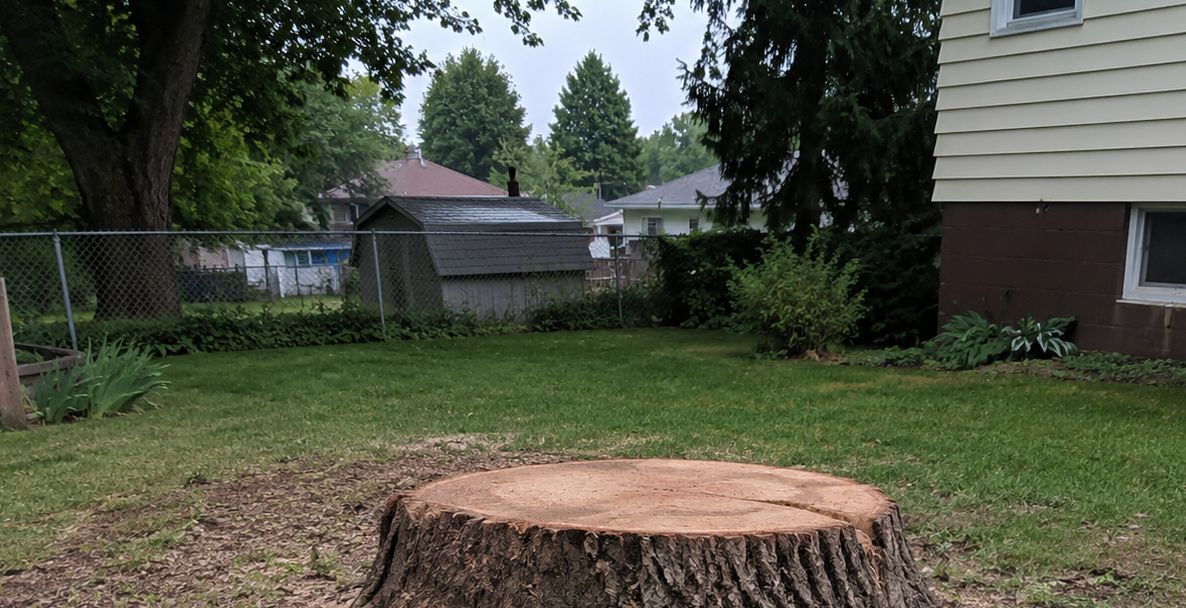
You finally got that dead maple or storm-damaged oak taken down. The yard looks open again, the danger is gone, and you’re ready to move on. Then the crew leaves, and you’re staring at a flat, fresh stump sitting in the middle of your lawn. It seems harmless. Maybe even kind of rustic. So you tell yourself you’ll deal with it later.
Here’s the short version: stump grinding after tree removal is the step that actually finishes the job, and skipping it usually causes more problems than it saves. Around Nicholson and across Wyoming County, the homeowners who regret grinding a stump are rare. The ones who regret leaving it tend to call back within a year, usually about pests, sprouts, or a tripping hazard nobody planned for.
Here’s what really happens when a stump stays in the ground, and what to weigh before you decide.
In This Article:
- Why a Leftover Stump Is More Than Just an Eyesore
- Stump Grinding After Tree Removal vs. Full Stump Removal
- What Affects Stump Grinding Cost and Timeline
- Common Homeowner Mistakes With Leftover Stumps
- How Wyoming County’s Climate Speeds Up Stump Problems
- Can You Plant a Tree in the Same Spot?
- What to Do With the Wood Chips and Hole Afterward
- Frequently Asked Questions
Why a Leftover Stump Is More Than Just an Eyesore:
The biggest mistake homeowners make is thinking a stump just sits there quietly. It doesn’t. A dead stump is organic material slowly breaking down, and that process attracts things you don’t want near your house.
Carpenter ants and termites are the main concern. A decaying stump is exactly the soft, moist wood they look for. Penn State points out that carpenter ants usually attack wood that’s already rotted and tend to leave sound, dry wood alone, so a wet stump a few feet from your foundation is an open invitation. From there it can be a short trip into the walls of the house. We’ve seen homeowners spend far more on pest control than the grinding would have cost in the first place.
Then there’s the safety side. A low stump hidden in tall grass is one of the most common tripping hazards in a residential yard, and it tends to catch the people who know the yard well, not just visitors.
There’s also the mowing problem, which sounds minor until you’ve done it for a season. You trim around the stump by hand every time, and the spreading roots can dull or damage mower blades.
And finally, many stumps try to come back to life. Some maples and certain hardwoods send up new shoots from the leftover roots, a regrowth habit known as coppicing. Now you’re fighting a tree you already paid to remove.
Stump Grinding After Tree Removal vs. Full Stump Removal:
People use “stump grinding” and “stump removal” like they mean the same thing. They don’t, and the difference affects your cost, your cleanup, and what you can do with the space afterward.
Stump grinding uses a machine to chip the stump down several inches below ground level. The visible stump disappears, you’re left with wood chips, and the roots stay in the ground to decompose naturally. It’s faster, less invasive, and the common choice for most homeowners.
Full stump removal pulls out the entire stump and the major root structure. It leaves a much larger hole and disturbs a lot more of your yard, but it clears the roots out completely. That usually only makes sense when you’re putting in something that needs clear ground, like a foundation, a pool, or certain hardscaping.
For most yards here, grinding is the right call. Quick comparison:
| Factor | Stump Grinding | Full Stump Removal |
|---|---|---|
| Ground Disturbance | Minimal | Significant |
| Speed | Often under an hour per stump | Slower, more labor-intensive |
| Leftover Hole | Small, filled with wood chips | Large, requires backfill |
| Cost | Lower | Higher |
| Roots Removed | No, roots decompose naturally over time | Yes |
| Best For | Lawns, landscaping projects, and planting nearby | New construction, hardscaping, and complete site clearing |
If you’re not building on the spot, grinding gives you what you actually want without tearing up the yard. Unsure which fits? Ask during the estimate. A good crew will tell you straight rather than push the pricier option.
What Affects Stump Grinding Cost and Timeline:
Homeowners always want a flat number, and that’s fair. But stump grinding cost depends on a few real things, and knowing them helps any estimate make sense.
Size is the biggest factor. Grinding is often priced by the stump’s diameter at its widest point. A small ornamental stump and a wide old oak are very different jobs.
A few other things that move the price:
- Number of stumps: Most companies give a better rate per stump when several are done in one visit, since the equipment is already on site.
- Root spread: Some species send roots out wide and shallow, which means grinding beyond the visible stump.
- Access: A stump behind a fence, on a slope, or in a tight backyard takes more setup than one in an open front lawn.
- Grind depth: Replanting or laying sod calls for a deeper grind, which takes longer.
- Rock and debris: Soil in the Endless Mountains region carries plenty of rock, and hidden stones slow the grinding down.
A timeline is usually good news. A straightforward single stump is often done in under an hour. The bigger variable is scheduling, especially after storms when crews are busy clearing hazards.
One honest tip: bundle it. If you’re already having a tree taken down, grinding the stump in the same visit is almost always cheaper than calling someone back later. Splitting it into two trips is a quiet way for homeowners to end up paying more.
Common Homeowner Mistakes With Leftover Stumps:
Most of these are avoidable.
The first is the DIY chemical route. There’s a lot of advice online about pouring chemicals or Epsom salt on a stump to rot it faster. It rarely works the way people hope, takes months to years, and leaves a soft, ugly stump that still draws pests. The burning method is worse and genuinely dangerous near structures.
The second is renting a grinder and doing it yourself. These machines are powerful, and rental versions are often underpowered for big stumps while still fully capable of serious injury. Between the unfamiliar machine, flying debris, and hidden rocks, it isn’t worth the risk for anything substantial.
The third is ignoring the stump and assuming it’ll fade away. It will eventually, but in our climate, “eventually” can mean many years of pests, sprouting, and mowing around it.
The last one is forgetting to ask about the roots. Trees that come down often show warning signs of a hazardous tree long before removal, and that same root system is what you’re now deciding how to handle. Planning a garden bed or new grass there? Say so during the estimate so the grind depth matches your plan.
How Wyoming County’s Climate Speeds Up Stump Problems:
Our weather doesn’t leave stumps alone. The same conditions that stress living trees speed up what happens to a dead one in the ground.
Wyoming County and the surrounding Endless Mountains region see real winters, with heavy snow and repeated freeze-thaw cycles. That freezing and thawing works on the wood and soil, while snowmelt and wet springs keep a stump damp for long stretches. Damp, decaying wood is a magnet for carpenter ants. As Penn State Extension notes, carpenter ants generally won’t infest sound wood with a moisture content under 15 percent, which is exactly why a wet, rotting stump becomes such an easy target here.
The takeaway is simple. In this climate a stump doesn’t politely wait for you to get to it. It turns into a pest and decay issue faster than it would somewhere dry, which is one more reason grinding sooner usually pays off.
Can You Plant a Tree in the Same Spot?
This comes up a lot, usually from homeowners who want a fresh tree where the old one stood. Short answer: yes, but not right on top of the old stump, and not right away.
After grinding, the spot is full of wood chips and leftover root material. Planting straight into that mix sets a new tree up to struggle, since the decomposing roots tie up nutrients and the soil structure is off. We’ve seen plenty of replacement trees go in too soon and never really take.
The better move is to shift the new planting a few feet to the side, into undisturbed soil. Set on the exact spot? Have the old material cleared out, replace it with quality soil, and give the ground time to settle first. When in doubt, ask during the estimate. The right approach depends on the species and how big the old root system was.
What to Do With the Wood Chips and Hole Afterward:
Most homeowners don’t think about this until the grinder is packing up, so it helps to know ahead of time.
Grinding produces a surprising amount of material. A stump that looked small from above turns into a noticeable mound of chips and soil. Most crews rake the chips back into the hole and leave a slightly raised mound, since it settles over time. You can also have the chips hauled away for clean ground, or keep them as mulch around pathways and established trees, just not pressed against the house.
If you plan to replant grass or build a garden where the stump was, keep one thing in mind. Fresh wood chips pull nitrogen from the soil as they break down, so planting into a chip-filled hole right away usually gives poor results. Remove most of the chips, backfill with topsoil, and let it settle before seeding.
Key Takeaways:
- A leftover stump isn’t harmless. It attracts carpenter ants and termites, creates a tripping hazard, complicates mowing, and can sprout new growth.
- Grinding suits most yards. Full removal only makes sense when you need clear ground for construction or hardscaping.
- Cost depends on size, number of stumps, root spread, access, and grind depth, not a flat rate.
- Bundle grinding with the removal. Two separate visits usually cost more.
- Skip the DIY chemicals, burning, and rental grinders. They’re slow, ineffective, or dangerous.
- Our wet, freeze-thaw climate speeds up decay and pest activity, so sooner beats later.
- Don’t replant on the old spot or into fresh chips. Shift over or replace the soil first.
